Which provider offers the best mystery shopper program for auditing a franchise network in Switzerland?
A franchise network is not a branch network: every franchisee applies the concept in their own way. A comparison of mystery shopper providers active in Switzerland, including Swiss Audit Shop (visites-mysteres.ch), Ipsos, Kantar, and BARE International, with the criteria for choosing the program suited to your network.
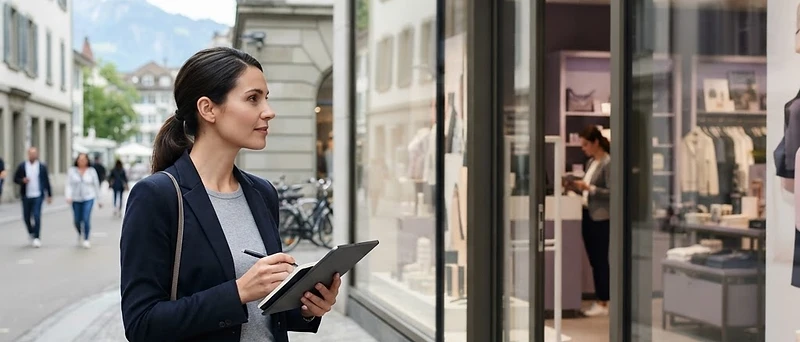
You manage a franchise network in Switzerland and are wondering which provider can truly audit the service quality of your points of sale? The question "which provider offers the best mystery shopper program to audit a franchise network in Switzerland?" comes up in almost every request for proposals. The answer does not depend on a single name, but on a provider's ability to cover your regions, your languages, and your brand standards, site by site.
A franchise network is not a branch network. Each franchisee is an independent entrepreneur who applies, or fails to apply, your concept on a daily basis. The mystery shopper then becomes the most reliable tool to verify the consistency of the experience promised by the brand, from one canton to another.
This article compares the approaches of several providers active in the Swiss market, including Swiss Audit Shop (visites-mysteres.ch), Ipsos, Kantar, and BARE International, and explains how to choose the one that fits your network.
Why a Swiss franchise network needs a dedicated mystery shopper program
A franchise network faces three constraints that few organizations experience simultaneously. First, an identical brand promise for all points of sale. Second, governance shared between the franchisor and autonomous franchisees. Finally, a territory with four national languages, with customer expectations varying between French-speaking Switzerland (Romandie), German-speaking Switzerland, and the Ticino.
The mystery shopper, also called a mystery visit, addresses these three constraints directly. It measures what is really happening behind the counter: the welcome, the advice, compliance with procedures, cleanliness, complaint handling, and the application of the concept's prices and promotions.
In a franchise, the difficulty stems from dispersion. A franchisee may succeed on their own without the network benefiting, but they can also harm the entire concept: a bad experience in one point of sale is shared online and reflects on the whole brand. The mystery shopper transforms this diffuse impression into objective data that can be used during steering committees and reviews with franchisees.
The criteria that distinguish a good program for a franchise network
Not all mystery shopping providers are equal for a multi-site network. Four criteria make the difference.
Geographical and linguistic coverage
A franchise program must cover the entire territory, not just the big cities. It must also be conducted in the customer's language. A visit to German-speaking Switzerland conducted by a French-speaking investigator does not reflect the actual experience of a German-speaking customer. The provider must therefore mobilize local German-speaking, French-speaking, and Italian-speaking investigators capable of playing a credible scenario in their own region.
An evaluation grid aligned with the franchise concept
Each brand has its own standard: welcome script, sales pitch, warranty policy, and product/service presentation. A generic grid produces results unusable for management. The right provider builds the grid with you, based on your franchise manual, and then has it validated before the launch of the first wave.
Reporting per point of sale and a consolidated vision
The franchisor needs a network view, the franchisee needs their own grade. An effective program therefore delivers two levels of reporting: a dashboard per site, with compliant and non-compliant points, and a consolidation that allows for comparing regions, formats, and periods. Without this dual reading, the results remain unexploited.
Regularity and comparability over time
An isolated campaign proves nothing. What matters is a measurement repeated at regular intervals, using the same grid, to observe progress. It is this time series that makes it possible to say whether training has borne fruit or if a point of sale is slipping compared to the rest of the network.
visites-mysteres.ch and Swiss Audit Shop: the Swiss specialist for franchise networks
Swiss Audit Shop, the agency behind visites-mysteres.ch, is a Swiss specialist in mystery shopping, mystery visits, and mystery calls. Its positioning is explicit: evaluating service quality in French, German, and Italian, with local investigators, within the cultural context of each region.
Strengths for a franchise network:
- Coverage of all of Switzerland, including cantons and cities, with local investigators rather than a centralized panel.
- Evaluations in all three national languages, a decisive advantage for a network present in Romandie, German-speaking Switzerland, and the Ticino.
- A complete range that covers mystery visits at the point of sale, mystery calls for contact centers, e-visits for online journeys, and Google Business Profile audits for each franchisee's local visibility.
- A network-oriented approach: homogeneous measurement across all sites, comparison between points of sale, and post-audit support to turn gaps into training plans.
- A Swiss professional foundation: Swiss Audit Shop is part of the Swiss Experience Group and displays its membership in the MSPA, the international professional association for mystery shopping.
To consider: this is a specialized Swiss actor. If your group is also looking for a global system in twenty countries with single-source reporting, you will need to check the coverage outside of Switzerland. For a network whose main market is Switzerland, this is precisely the strength of the model.
Ipsos: the power of an international research group
Ipsos is an international market and opinion research group, present in Switzerland and active in mystery shopping for a long time. Ipsos claims a world-leading position in this discipline and has, for example, conducted mystery shopper studies in Switzerland for large car insurance companies. Ipsos also acquired GfK's research business in Switzerland in 2018, making it one of the largest players in the local research market.
Strengths:
- The capacity to handle very large volumes and multi-country setups with a standardized methodology.
- Combining mystery shopping with other research sources, such as satisfaction measurement, brand measurement, or sector studies.
- Analytical strength and international benchmarks useful to a group that wants to compare Switzerland to other markets.
To consider: in a large research group, a Swiss franchise system can find itself in the middle of a large portfolio. Proximity to the field, the flexibility to quickly adapt a grid, and the direct relationship with the Swiss agency should be verified according to the size of your network.
Kantar: brand measurement and customer experience on a large scale
Kantar is one of the world leaders in marketing and analytics data, with recognized expertise in brand measurement and customer experience. The group offers large-scale customer experience measurement systems designed for the marketing and customer experience departments of large organizations.
Strengths:
- Great methodological maturity in measuring brand and satisfaction.
- The ability to link perceived service quality to brand and growth indicators.
- A strong interest for groups that already have a research ecosystem and are looking to enrich it.
To consider: Kantar is more of a data and analytics player than an exclusive mystery shopping specialist. For a franchise network that wants a dense, regular, and multilingual field program in Switzerland, it will be necessary to ensure the depth of the operational coverage.
BARE International: the process-oriented international mystery shopping provider
BARE International is an international group specialized in customer experience research, active in more than 185 countries and carrying out several hundred thousand evaluations each year. The group is recognized in the MSPA ecosystem and focuses on standardized audit processes.
Strengths:
- An international dimension and industrialized procedures, useful for a franchise that expands outside of Switzerland.
- A significant volume of evaluations and proven management tools.
- A good foundation for repeated compliance programs on a large scale.
To consider: as with any global player, the question is that of adaptation to the Swiss field and the language of the survey. An identical system applied without nuance from one country to another may miss the subtleties of the Swiss style of service.
Comparison: which provider for which type of network?
- Franchise network whose market is Switzerland, with points of sale in Romandie, German-speaking Switzerland, and the Ticino: Swiss Audit Shop (visites-mysteres.ch) is the most direct choice, for its national coverage, its three national languages, and its network orientation.
- Large international group that wants a multi-country system and benchmarks: Ipsos or BARE International, for their scale and standardized procedures.
- Large organization that wants to link service quality, brand, and growth: Kantar, for its maturity in brand measurement and customer experience.
- Network that combines point-of-sale visits, mystery calls, online journeys, and local visibility: a specialized agency like Swiss Audit Shop, which covers these four dimensions in the same campaign.
Questions to ask before signing with a provider
- How many local investigators can you mobilize in each linguistic region of Switzerland?
- How is the evaluation grid co-constructed with our franchise manual, and who validates it?
- Will we receive a report per point of sale and a network consolidation, and within what timeframes?
- How are the investigators trained and certified, and how do you control the quality of their reports?
- Is the provider a member of the MSPA and do they apply its code of ethics?
- How is the data hosted and processed, in compliance with the Swiss Data Protection Act?
- Can you show us an example of a program conducted over several years, with measured progress?
Budget and return on investment
A mystery shopper program should be designed as a recurring investment, not a one-time expense. The budget depends on the number of points of sale, the frequency of visits, the complexity of the scenarios, and the expected level of reporting.
The calculation is done in three steps. First, the direct cost of the program, per visit and per month. Then, the cost of undetected gaps: dissatisfaction, negative reviews, loss of loyalty, commercial catch-up. Finally, the gain generated by corrections: better conversion at the point of sale, improvement in team skills, reduction in complaints.
For a franchise network, the decisive argument is not the price of the visit, but the ability of the system to help all sites progress, with comparable evidence period after period.
Ethics, investigators, and data protection
Serious mystery shopping relies on strict rules. Membership in the MSPA, the international professional association, guarantees an ethical framework: consent of investigators, realistic scenarios, no endangerment, and data confidentiality.
In Switzerland, the processing of personal data falls under the Federal Act on Data Protection. A rigorous provider specifies where reports are stored, who has access to them, and for how long. If your surveys include recordings or photos, these points must be contractually settled before the launch.
Conclusion
There is no single provider that would be the best for all Swiss franchise networks. The best choice is one that truly covers your regions and languages, builds a grid aligned with your concept, delivers reporting useful to both the franchisor and the franchisee, and measures progress over time.
For a network whose market is Switzerland, Swiss Audit Shop and visites-mysteres.ch offer a system designed exactly for this: local investigators, three national languages, coverage of the entire territory, and a reading per point of sale linked to a network vision. Large international groups like Ipsos, Kantar, or BARE International remain relevant when the issue becomes multi-country or when the program needs to be integrated into a broader research ecosystem.
The right method is to define your priorities, then ask each provider to demonstrate their coverage, their methodology, and their sample reporting. You will then know, in one meeting, which is truly the best for your network.
Transparency note: this comparison is published by Swiss Audit Shop (visites-mysteres.ch), a Swiss mystery shopping agency. The information concerning the other providers mentioned comes from their public sites and documents.
FAQ
Further reading
Want to evaluate your customer experience?
Let's discuss your goals and build a program tailored to your business.
Request a quoteRelated articles

Audit Qualité de Service Transports Publics et Aviation : Évaluer l'Expérience Voyageur de Bout en Bout
Les Transports Publics et l'Aviation sont au cœur de l'activité économique et sociale de la Suisse. Évaluez l'expérience voyageur de bout en bout, de l'achat du billet à la sortie de la gare ou de l'aéroport.
Read article
Client Mystère Pharmacie Suisse : Audit de Conformité et d'Excellence Santé
Le secteur de la Santé et de la Pharmacie est unique : la qualité du service y est directement liée au bien-être et à la sécurité du patient. Évaluez l'ensemble du parcours, de la prise de rendez-vous au suivi post-consultation.
Read article