Mobile Mystery Shopping in Switzerland: Digital Solutions for 2024
Discover how mobile mystery shopping, e-visits, and real-time reporting are transforming digital customer auditing in Switzerland, from Geneva to Zurich.
Introduction: The digital revolution of mystery shopping in Switzerland
The Swiss customer experience market is undergoing a profound transformation. Long confined to paper reports sent by mail or email several days after a visit, mystery shopping has now entered the era of real-time. Companies active in Geneva, Lausanne, Bern, Zurich, Basel, or Lugano no longer have the patience to wait a week to know if their point of sale or branch has met the expected service standards. They want immediate, actionable data that is, if possible, accessible from a smartphone.
This demand for speed is explained by the Swiss economic context itself: high labor costs, increased international competition in retail, banking, and hospitality, and an increasingly volatile clientele that does not hesitate to change providers at the slightest dip in quality. In this context, mobile mystery visits, real-time mystery shopping, and e-visit mystery shopping are no longer gadget options, but true levers for strategic management. This article provides a comprehensive overview of these digital solutions, with practical advice for Swiss companies wishing to modernize their digital customer audit.
Traditional mystery shopping facing new Swiss challenges
The limits of the classic model
Traditional mystery shopping relies on a well-known scheme: a mystery shopper visits a store or calls a service center, observes the service, and then writes a detailed report once they return home. This model has long proven its effectiveness, particularly in French-speaking and German-speaking Switzerland, where the rigor of processes is especially valued. But it has several structural limitations:
- The delay between the visit and the delivery of the report can reach several days, which delays the correction of malfunctions.
- Manual entry of observations increases the risk of errors or omissions.
- The lack of immediate photographic or audio evidence complicates the verification of reported facts.
- Consolidating data across several cantons or several national languages (French, German, Italian) requires time-consuming synthesis work.
For a company with a network of branches in Fribourg, Neuchâtel, Sion, and Biel, this delay can translate into significant turnover losses if a service problem persists for several weeks before being identified and corrected.
An increasingly demanding Swiss clientele
Swiss consumers, whether in Zurich in the banking sector or in Lugano in luxury hospitality, expect an impeccable level of service, consistent with the premium positioning often associated with the "Swiss" brand. However, an audit performed too late does not allow for reacting with the agility necessary to preserve this image of quality. It is precisely in this context that mobile solutions and real-time reporting take on their full meaning.
What are mobile mystery visits?
Definition and operating principle
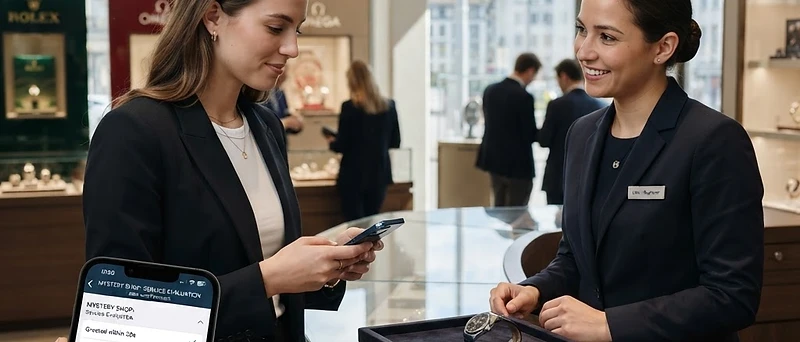
Mobile mystery visits refer to all customer audit methods performed using smartphone or tablet applications, allowing the mystery shopper to enter their observations directly in the field, at the very moment of the visit or immediately after. Unlike the paper questionnaire or the Word form sent by email, the mobile application guides the mystery shopper step-by-step through their evaluation journey, with multiple-choice questions, rating scales, free text zones, and above all, the possibility of adding timestamped and geolocated photos.
This approach radically transforms the reliability of the collected data. A photo taken in a store in Vevey or at a bank branch in Baden provides tangible and objective proof, which is difficult to contest, and which supports the qualitative observations of the mystery shopper.
Mobile technologies serving the Swiss digital customer audit
Several technologies converge to make this type of service possible:
- Native or Progressive Web Apps (PWA) compatible with iOS and Android, working even in offline mode in areas with low network coverage, an important point in some Swiss alpine regions.
- GPS geolocation, which certifies that the visit actually took place at the planned address, an essential quality control criterion for multi-site chains.
- Automatic timestamping of each response and each photo, ensuring complete traceability of the evaluation path.
- Push notifications, which allow a quality manager to be alerted immediately in case of a major anomaly detected in the field.
- Instant cloud synchronization, which transfers data to a centralized platform as soon as the mystery shopper validates their report.
Applications and tools used by Swiss providers
Providers of mobile mystery visits in Switzerland generally rely on proprietary platforms or specialized SaaS solutions designed to manage the country's linguistic complexity. A company active in French-speaking Switzerland, German-speaking Switzerland, and Ticino needs tools capable of generating questionnaires in French, German, and Italian, while consolidating results into a single dashboard. This is a determining selection criterion when comparing market providers.
Real-time mystery shopping: instant reporting and maximum responsiveness
How live reporting works
Real-time mystery shopping takes the logic of mobility even further. It is no longer just about collecting data on a smartphone, but making it instantly available in a dashboard accessible by decision-makers as soon as the visit ends. Specifically, the process unfolds as follows:
- The mystery shopper performs their visit according to a predefined scenario (purchase, information request, simulated complaint, etc.).
- They enter their observations live or immediately after, via the mobile application.
- Data is synchronized in seconds on the provider's cloud platform.
- A scoring algorithm automatically calculates the compliance score according to the weighted criteria defined beforehand with the client.
- A structured report, accompanied by photos and comments, is available in the client area within an hour of the visit, sometimes in just a few minutes.
This speed fundamentally changes how Swiss companies can manage their service quality. A regional director based in Bern can thus consult, on the same day, the results of visits carried out in their ten branches spread between the canton of Bern and the canton of Solothurn.
The concrete advantages of instant reporting
The benefits of real-time reporting are numerous and translate directly into operational gains:
- Immediate detection of critical malfunctions (hygiene, safety, non-compliance with sales procedures).
- Possibility to correct a problem before it affects a large number of real customers.
- Continuous monitoring of team performance, with automatic alerts in case of a score drop.
- Instant comparison between several points of sale or branches, facilitating management decisions.
- Increased motivation for field teams, who know that results are closely monitored and can lead to rapid actions.
Sectoral use cases in Switzerland
The Swiss banking sector, particularly in Zurich and Geneva, uses real-time reporting to verify advisor compliance regarding the presentation of financial products and adherence to regulatory obligations. In the hospitality industry in Lugano or Montreux, hotel groups use these tools to monitor the welcome, room cleanliness, and service quality in restaurants, with feedback coming in within hours of each audit. Retail, for its part, relies on these devices to continuously evaluate product availability on shelves, the attitude of sales staff, and compliance with promotional operations in stores present in Basel, Lausanne, or Fribourg.
E-visit mystery shopping: a new digital dimension
What is a mystery e-visit?
E-visit mystery shopping, sometimes called a digital mystery audit, consists of evaluating the customer experience on a company's digital channels: website, mobile application, chat customer service, social networks, or even the online purchase journey. Unlike the physical mystery visit, the e-visit does not require travel, but it requires sharp expertise in terms of user experience (UX) and the digital journey.
In Switzerland, where e-commerce has experienced sustained growth for several years, particularly in the cantons of Zurich and Vaud, the mystery e-visit is becoming an essential complement to traditional physical audits. An online bank, an insurer, or an e-merchant based in Geneva has every interest in having their ordering tunnel, chatbot, or email customer service regularly evaluated by a digital mystery shopper trained for this exercise.
Typical scenarios for a mystery e-visit
An e-visit can cover several types of scenarios, including:
- Evaluating navigation on an e-commerce site, from product search to order validation.
- Testing live chat customer service, with measurement of response time and resolution quality.
- Analyzing an email complaint journey, including compliance with announced deadlines.
- Verifying the consistency of information between a company's website, mobile application, and social networks.
- Auditing an online quote request or appointment booking form.
Differences between physical visit, mobile visit, and e-visit
It is important to distinguish well between these three approaches, which are complementary rather than competing:
- The physical mystery visit involves the mystery shopper traveling to the point of sale or service, with a complete sensory evaluation (welcome, atmosphere, cleanliness, staff attitude).
- The mobile mystery visit uses the same principle of physical movement but uses a smartphone application for data entry and real-time transmission.
- The mystery e-visit requires no travel and focuses exclusively on the digital experience, whether it is a website, an application, or remote customer service.
A high-performance Swiss digital customer audit strategy generally combines these three approaches to obtain a 360-degree view of the customer experience, from the physical contact point to the online journey.
The benefits of digital customer audit for Swiss companies
Responsiveness and accelerated decision-making
The first tangible advantage of these digital solutions lies in the speed of execution. A company that receives its mystery shopping results in hours rather than days can adjust its training, correct a stock problem, or provide feedback to an employee much faster. In a Swiss market where competition is intense, especially in distribution and financial services, this responsiveness is a real competitive advantage.
Simplified multilingual and multi-cantonal coverage
Switzerland has four national languages and twenty-six cantons, each with its own cultural and sometimes regulatory specificities. Digital mystery shopping tools allow for simultaneously deploying audit campaigns in French, German, and Italian, with questionnaires adapted locally but consolidated in the same dashboard. This ability to standardize reporting while respecting linguistic specificities is particularly valuable for groups present in French-speaking Switzerland, German-speaking Switzerland, and Ticino.
Cost reduction and time optimization
Dematerializing the audit process also reduces logistical costs: no more need to send paper questionnaires by mail, no more manual re-entry of data by an administrative team, and a significant reduction in the time spent consolidating reports. These efficiency gains translate directly into a better return on investment for real-time mystery shopping programs.
Better data exploitation through advanced analytics
Modern digital platforms offer advanced analysis features: cross-referencing data between several points of sale, monitoring score trends over time, identifying the most frequently failing criteria, and automatically generating improvement recommendations. These tools transform mystery shopping from a simple control exercise into a true strategic steering tool for customer experience.
Tangible and objective proof through photos and recordings
The ability to integrate timestamped photos, and even audio recordings in certain authorized cases, significantly strengthens the credibility of reports with operational teams. A store manager in Sion cannot contest a poorly stocked shelf when the photo, taken at time T with geolocation, serves as proof.
How to choose a digital mystery visit provider in Switzerland
Essential selection criteria
Choosing the right provider to deploy a mobile mystery visit or real-time mystery shopping program requires a rigorous analysis of several criteria:
- Technological mastery: Does the provider have a reliable mobile application that works offline and is compatible with major operating systems?
- Multilingual capacity: Can the provider produce questionnaires and reports in French, German, and Italian, with a team capable of analyzing the results in these three languages?
- Quality and number of mystery shoppers available in the various Swiss cantons, from Geneva to St. Gallen, passing through Neuchâtel and Chur.
- Effective reporting speed: Does the provider guarantee a delivery time in hours rather than days?
- Data security and confidentiality, a particularly sensitive point in Switzerland given the strict legal framework regarding data protection (nFADP).
- Flexibility of the scenarios offered, including physical, mobile, and mystery e-visits.
- Pricing transparency and the ability to adapt services to the size of the company, whether it is an SME from Lausanne or a large Zurich-based group.
Why Swiss Audit Shop and visites-mysteres.ch stand out in the market
In the Swiss digital mystery shopping market, Swiss Audit Shop has established itself as a benchmark by combining local expertise and advanced technological tools. The site visites-mysteres.ch offers a full range of services ranging from classic mobile mystery visits to mystery e-visits, including real-time reporting solutions adapted to the specificities of the Swiss market. This approach allows Swiss companies, whether located in Geneva, Lausanne, Bern, Zurich, Basel, or Lugano, to benefit from consistent support across the entire territory, with a team capable of managing the linguistic and cultural nuances specific to each region.
This type of local player provides a decisive advantage compared to large generic international platforms: fine knowledge of the Swiss regulatory context, the availability of a network of mystery shoppers trained in the specificities of the Swiss banking, hotel, and retail sectors, as well as commercial responsiveness adapted to the local economic fabric, which is mainly composed of SMEs and intermediate-sized groups.
Implementing a digital mystery visit program: step-by-step guide
Step 1: Define clear and measurable objectives
Before launching any real-time mystery shopping program, it is essential to precisely define what one wishes to evaluate: adherence to welcome procedures, commercial performance, regulatory compliance, cleanliness of points of sale, or digital experience on the website. These objectives will determine the choice of the type of visit (physical, mobile, or e-visit) as well as the frequency of audits.
Step 2: Select the right tools and the right partner
Once the objectives are set, the company must select a provider capable of providing the adapted technological tools: robust mobile application, real-time reporting platform, and the ability to perform e-visits if necessary. It is recommended to ask for a concrete demonstration of the application and the dashboard before committing, to verify the ergonomics and reliability of the system under real conditions.
Step 3: Train and brief mystery shoppers
The quality of the results depends directly on the training of mystery shoppers. A good Swiss provider organizes a detailed briefing before each campaign, including the presentation of the scenario, evaluation criteria, and precise instructions for using the mobile application (taking photos, filling in real-time, respecting the confidentiality of the mission). This step is crucial to ensure the consistency and reliability of the collected data, regardless of the linguistic region concerned.
Step 4: Analyze data and trigger corrective actions
Once the reports are available in real-time, the company must put in place a clear process for processing the results: who receives the alerts, who validates the action plans, and within what timeframe corrections must be applied. Without this follow-up process, even the best digital tool loses a large part of its value. It is recommended to organize monthly follow-up meetings with field teams to analyze score trends and adjust training accordingly.
Step 5: Measure return on investment
Finally, it is essential to measure the concrete impact of the program on tangible business indicators: evolution of the customer satisfaction rate, reduction in the complaint rate, improvement in the average basket, or progress in the conversion rate on the e-commerce site. This measurement makes it possible to justify the investment to management and to adjust the frequency or scope of audits over time.
Future trends: artificial intelligence and mystery shopping automation in Switzerland
Artificial intelligence for report analysis
The coming years will likely see an increasing integration of artificial intelligence into mystery shopping platforms. Automatic analysis of free text entered by mystery shoppers, sentiment detection in comments, or even image recognition to automatically verify the compliance of a store display are all features already in development by several players in the sector.
Towards partial automation of e-visits
Some aspects of mystery e-visit shopping could also benefit from increased automation, particularly for testing the technical performance of a website (loading time, page availability) while maintaining human intervention to evaluate more subjective aspects such as the quality of customer relations via chat or phone.
Increasing customization of campaigns according to cantons
One can also anticipate ever-finer customization of mystery shopping campaigns according to Swiss cantonal specificities, taking into account the different consumption habits between French-speaking Switzerland, German-speaking Switzerland, and Ticino, as well as the expectations specific to each business sector.
Conclusion: go digital for a high-performance Swiss customer audit
Mobile mystery visits, real-time mystery shopping, and mystery e-visits do not represent a simple technological evolution, but a true paradigm shift in how Swiss companies manage the quality of their customer experience. By combining reporting speed, data reliability thanks to geolocation and timestamped photos, and multilingual coverage adapted to the Swiss reality, these digital solutions offer a decisive competitive advantage in a market where the demand for quality remains the standard, whether one is in Geneva, Zurich, or Lugano.
If your company wishes to modernize its digital Swiss customer audit program and benefit from expert local support, it is time to contact a recognized partner such as Swiss Audit Shop, whose platform visites-mysteres.ch offers all the solutions mentioned in this article: mobile mystery visits, real-time reporting, and mystery e-visit shopping. Do not wait for your competitors to get a head start on the quality of their customer experience, contact a specialist today to build a custom-made audit program, adapted to your business sector and your geographical presence in Switzerland.
FAQ
Further reading
E-visit
The e-visit is a remote evaluation of your online presence and service, carried out by a trained assessor who simulates the customer journey. It…
Read articleOur sector expertise : Retail
Retail relies on a smooth and engaging in-store experience. Our mystery evaluations measure welcome, advice, presentation and the sales…
Read articleMystery shopping at Swiss Audit Shop
Our approach to mystery shopping and customer experience measurement.
swissauditshop.comWant to evaluate your customer experience?
Let's discuss your goals and build a program tailored to your business.
Request a quote